LONGi Hi-MO array
Off-grid solar system for an office — a LONGi array of 18 × 550 W
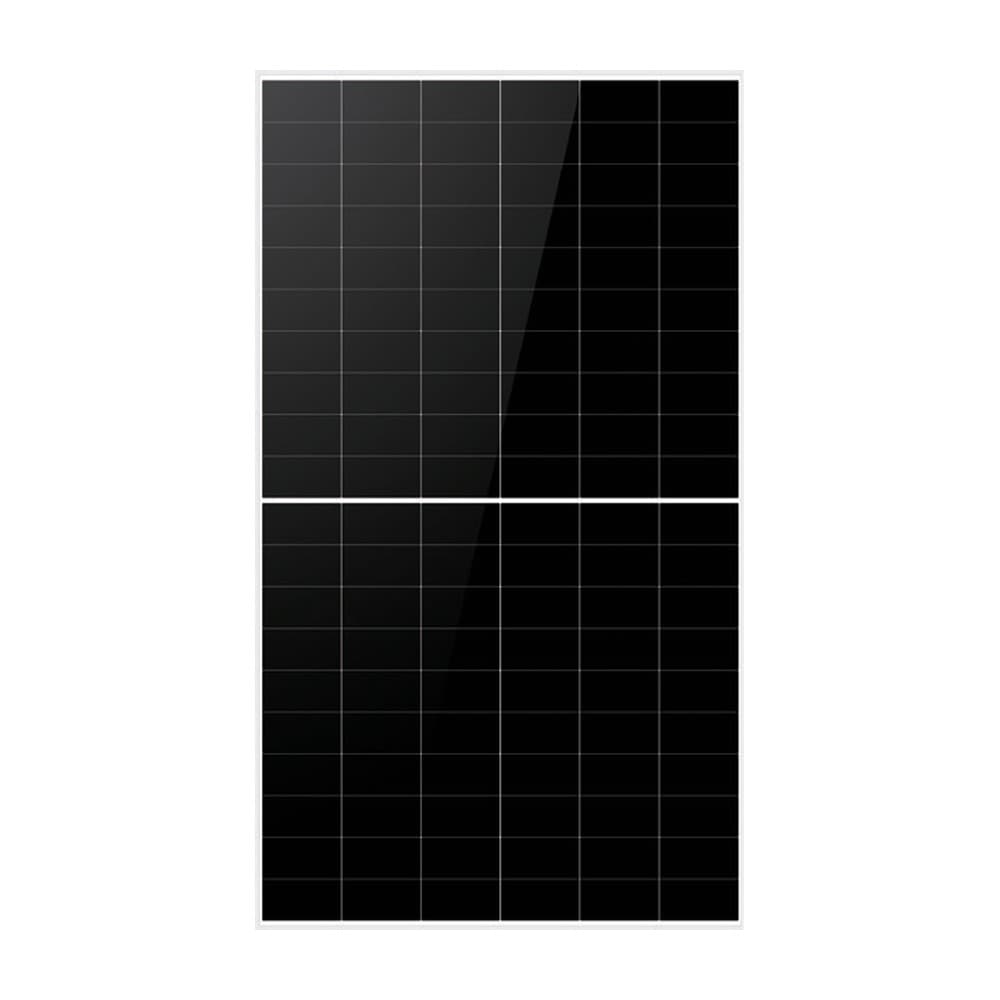
18 × Hi-MO X10 Guardian LR7-60HVHL 550W: that is the LONGi array for an office with no grid supply at all. Per day the profile runs 3 × air conditioner (1,200 W for 8 h), 2 × lights & Wi-Fi (200 W for 8 h), 4 × computers (200 W for 8 h) and kitchen (microwave & kettle) (2,000 W for 1 h). The load asks for 9.5 kWp and these modules install 9.9 kWp. Two more lines stand next to the array — an inverter at 10 kW, storage at 41 kWh. Each is a rating and not a product, since panels are the whole of this store's LONGi range.
One module measures 1990 × 1134 mm and weighs 16.3 kg; the 18 together put 40.6 m² of glass and 293 kg on the roof.
What is inside
Inverter×1
Inverter rating to match: 10 kW (a size, not a LONGi unit)
Battery×8
Storage rating to match: 41 kWh, counted as 8 × 5.12 kWh (a size, not a LONGi unit)
The array, read from the module's record
The count comes from the energy, not from the roof. Added up, the appliances of this profile draw close to 40.4 kWh in twenty-four hours; the sizing assumes 5.7 hours of peak sun, which puts the array at 9.5 kWp. The calculator then takes the LONGi listing nearest 550 W, the Hi-MO X10 Guardian LR7-60HVHL 550W, and rounds up: 18 × 550 W is 9.9 kWp.
The Hi-MO X10 Guardian LR7-60HVHL at 550 W converts 24.4% of the light on its face and measures 1990 × 1134 × 30 mm — 244 W for each square metre of module. At 16.3 kg it loads the roof with 7.2 kg per m², the lowest figure of any module in this catalogue. The front is single glass, 1.6mm coated semi-tempered glass.
Side by side, the 18 modules are 40.6 m² of glass; their 293 kg is counted without rails or clamps. The 47 m² this page shows is larger because it is the sizing's allowance per module, not the glass itself. The record rates each module for 3,600 Pa of static load on its front and 2,400 Pa on its rear, and its hail test reads: 25mm Hailstone at the speed of 23m/s.
Electrically, a string gains 45.08 V of open-circuit voltage with every module, and 37.31 V once the modules work at full power, where each carries 14.74 A (15.45 A short-circuit). Wired as two strings of 9, the array stands at 405.7 V open-circuit and works at 335.8 V per string. The module itself sets a limit of 1500 V of system voltage, with a 25 A series fuse — 33 modules in a string at test conditions; open-circuit voltage climbs 0.2% for every °C the cells cool below 25 °C. The inverter chosen for the kit sets a tighter limit, and its DC window is the one the strings must fit.
On a hot roof, read the power coefficient first: this module's record gives -0.26%/°C. Ten degrees of cell temperature above the 25 °C test point take 2.6% off the rating — about 0.26 kW across this array. The record's nominal operating cell temperature is 45±2°C.
The inverter line reads 10 kW: with the motors of this profile starting together, the draw peaks at 9.2 kW. The storage line reads 41 kWh: a full day of use with a reserve for a day without sun comes to about 40.4 kWh. Both are sizes to buy against, not LONGi products: what can be ordered on this page is the modules.
The same array in another LONGi module
The calculator always takes the listing nearest 550 W. The roof of an office can have reasons to choose differently; each module below is counted for the same 9.5 kWp, with what its own record says and what that number of modules costs.
- Hi-MO X10 Guardian LR7-72HVHF 670W
15 for 9.5 kWp — the anti-dust frame with HPBC 2.0 cells, listed for commercial and industrial roofs — AED 6,240
- Hi-MO X10 Scientist LR7-72HVD 665W
15 for 9.5 kWp — its record names commercial and industrial cement roofs and high-temperature sites — AED 6,195
- EcoLife LR7-54HJD 510W
19 for 9.5 kWp — the most watts per m² of roof in the catalogue (250 W/m²) — AED 6,023
About this array
Which LONGi panel is counted for this office array, and how many?
18 panels of the Hi-MO X10 Guardian LR7-60HVHL 550W, a 24.4% module. Together they are 9.9 kWp, which covers the 9.5 kWp this load works out to.
How much roof and how much weight is that?
40.6 m² of module (18 × 2.26 m²) and 293 kg. This page allows 47 m² of roof for them, which leaves space around the rows.
What do the LONGi panels of this array cost?
18 × AED 341 is AED 6,138, or AED 0.62 per watt. That figure is the modules alone — no inverter, battery, mounting or labour. The module's own page prints the same amount per panel, and our store in Dubai or Riyadh is where the array changes hands.
What voltage do these panels put on a string?
Wired in series, every module brings a Voc of 45.08 V and a Vmp of 37.31 V. The record's system limit is 1500 V — 33 modules at test conditions — and the inverter's DC input range, lower than that, decides the real string length.
Are the inverter and the battery on this page LONGi products?
No. They are the sizes this load needs — 10 kW and 41 kWh — shown so the array can be matched to them. What this store lists from LONGi is 234 models of solar panel.
Can the same array be built from fewer panels?
Yes: 15 panels of the Hi-MO 9 Edge LR8-66HYD 670W reach the same 9.5 kWp, where this page counts 18. The panel itself is bigger — 670 W · 24.8% efficiency · 2382 × 1134 mm · 35.7 kg — so measure your rails against that length before choosing it.
Other LONGi arrays: this building, and this grid option
- Solar system for an office with evening backup power — a LONGi array of 17 × 550 W
- Solar system for an office with overnight backup power — a LONGi array of 17 × 550 W
- Off-grid solar system for an apartment — a LONGi array of 6 × 550 W
- Off-grid solar system for a house — a LONGi array of 11 × 550 W
- Off-grid solar system for a villa — a LONGi array of 22 × 550 W
- Off-grid solar system for a shop — a LONGi array of 11 × 550 W
- Off-grid solar system for a farm — a LONGi array of 3 × 550 W