Solar Panels to Run an Air Conditioner: the LONGi Count
A 1.5-ton air conditioner needs four 550 W LONGi panels on our calculator's figures. The arithmetic for 1, 1.5 and 2 tons, step by step.
The short answer for the most common unit, a 1.5-ton split: four 550 W panels. That is what our sizing calculator returns for one air conditioner on a grid-tied roof. This article shows the arithmetic behind that number, so you can redo it for a bigger unit, a longer day or more than one room.
What the calculator assumes about an air conditioner
The calculator's air-conditioner entry comes in three sizes, each with a running power: 1 ton is 900 W, 1.5 tons is 1,200 W and 2 tons is 1,800 W. It counts 8 hours of running a day and a start-up surge of three times the running power. The surge is the compressor's inrush current; it decides the inverter, not the number of panels.
Two more figures turn a day's energy into an array. The first is peak sun hours: 5.7 a day, the figure the calculator uses for the UAE, where our stores are. The second is the performance ratio — the share of nameplate power that reaches the socket after heat, dust, cabling and conversion — set at 0.8 for a grid-tied or backup system and 0.75 for an off-grid one.
The arithmetic, step by step
- Daily energy = running watts × hours ÷ 1,000. For a 1.5-ton unit: 1,200 × 8 ÷ 1,000 = 9.6 kWh a day.
- Array size = daily energy ÷ (sun hours × performance ratio). 9.6 ÷ (5.7 × 0.8) = 2.11 kWp.
- Panel count = array size ÷ panel power, rounded up. 2,110 W ÷ 550 W = 3.8, so 4 panels, which is 2.2 kWp on the roof.
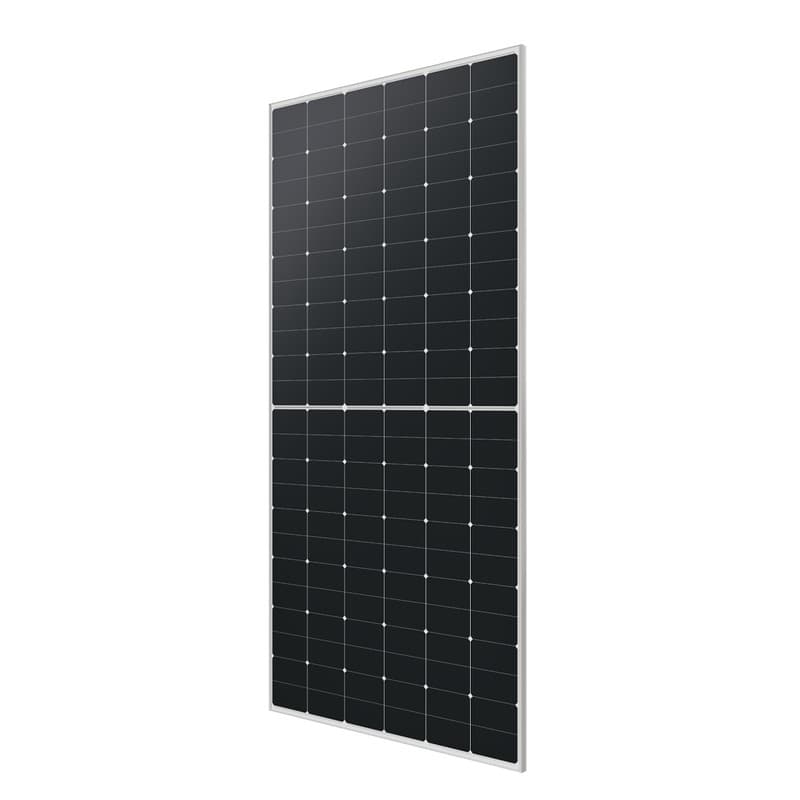
The panel in that sum is the one the calculator picks from our catalogue, the Hi-MO X10 Guardian LR7-60HVHL 550W. Its record states 550 W at 24.4% module efficiency, 1,990 × 1,134 × 30 mm, 16.3 kg ±1% and a power temperature coefficient of −0.260%/°C. The whole table is on the LR7-60HVHL 535–560 W datasheet.
Panels per air conditioner
| Air conditioner | Running power | Energy per day | Array needed | 550 W panels, grid-tied or backup | 550 W panels, off-grid |
|---|---|---|---|---|---|
| 1 ton | 900 W | 7.2 kWh | 1.58 kWp | 3 | 4 |
| 1.5 tons | 1,200 W | 9.6 kWh | 2.11 kWp | 4 | 5 |
| 2 tons | 1,800 W | 14.4 kWh | 3.16 kWp | 6 | 7 |
| Two 1.5-ton units | 2,400 W | 19.2 kWh | 4.21 kWp | 8 | 9 |
The off-grid column is larger because the calculator lowers the performance ratio to 0.75 when there is no grid to lean on: 9.6 ÷ (5.7 × 0.75) = 2.25 kWp, and that is five panels.
On the roof, the calculator reports about 8 m² for three panels, 10 m² for four and 16 m² for six. Each 550 W panel is listed at AED 341, so the four panels of a 1.5-ton unit come to AED 1,364 — the price on the product page is the price you pay.
At start-up the inverter matters more than the panels
A 1.5-ton unit running at 1,200 W asks for 1,200 × 3 = 3,600 W for the instant its compressor starts. The calculator therefore sizes a 4 kW inverter for that one unit, a 3 kW inverter for a 1-ton unit and a 6 kW inverter for a 2-ton unit.
Our catalogue is solar panels. On the result page the panel line is a named LONGi module with its price, while the inverter line is a specification to buy against — "One 4 kW hybrid inverter" — and not a model. The battery line works the same way. Choose evening backup and the calculator reserves four hours of the day's energy, 9.6 × 4 ÷ 24 = 1.6 kWh for a 1.5-ton unit, and shows one 5.12 kWh battery module as a capacity.
Does the country change the answer?
The arithmetic does. The engine behind the calculator holds a sun-hour figure per country: 5.8 for Saudi Arabia, 5.7 for the UAE and Oman, 5.6 for Qatar, Kuwait and Bahrain, 5.4 for Iraq and 3.7 for France. Redo step 2 with your own figure. At 5.8 a 1.5-ton unit still needs four panels (2.07 kWp); at 5.4 it needs five (2.22 kWp is 4.04 panels, rounded up); at 3.7 it needs six (3.24 kWp). For Lebanon, Syria, Yemen and Sudan the engine holds no measured figure and falls back to 5.0, which also gives five panels. The calculator page itself sizes on the UAE figure. Panel prices for the Kingdom are on the LONGi price page for Saudi Arabia.
An air conditioner is rarely alone
The ready-made systems put the unit back into a household. The apartment system with evening backup carries one air conditioner, a fridge, lights and Wi-Fi, a TV and a washing machine: 13.8 kWh a day, six 550 W panels, a 5 kW hybrid inverter line and one 5.12 kWh battery module on about 16 m² of roof. The grid-tied system for a house has two air conditioners and a kitchen appliance on top: 25.4 kWh a day, 5.57 kWp needed, eleven panels and a 9 kW inverter line. The grid-tied villa system, with four air conditioners, reaches 49.53 kWh a day and twenty panels.
Three things that move the number
- Hours. Twelve hours a day instead of eight turns a 1.5-ton unit into 1,200 × 12 ÷ 1,000 = 14.4 kWh, the same energy as a 2-ton unit at eight hours: six panels instead of four.
- Panel power. With a 650 W module such as the Hi-MO X10 Scientist LR7-72HVH 650W, a 2-ton unit needs 3,160 ÷ 650 = 4.9, so five panels instead of six. A 1.5-ton unit still needs four, because 2,110 ÷ 650 = 3.2 rounds up to the same count.
- Heat. A cell 40 °C above the 25 °C test condition loses 40 × 0.26 = 10.4% of its rated power on the 550 W module's stated coefficient. The 0.8 performance ratio is there to absorb exactly this.
For a whole house, the general method is in how many solar panels do I need. For your own rooms, open the calculator, pick 1, 1.5 or 2 tons for each unit — up to eight units — add the rest of the house and choose grid-tied, backup or off-grid. Panels ordered on the site are collected from our store in Dubai or Riyadh.
Frequently Asked Questions
How many solar panels does a 1.5-ton air conditioner need?
Will a split AC run straight off the panels with no battery?
How many solar panels for a 2-ton air conditioner?
Which inverter rating suits a 1.5-ton AC on a solar system?
- #solar panels for air conditioner
- #how many solar panels
- #solar AC sizing
- #1.5 ton AC solar
- #LONGi 550W
- #solar calculator
Ready to order?
Every unit in the catalogue carries its price — add it to the cart and order online, then collect it from our store in Dubai or Riyadh.